.png)
Marketing for therapists is the process of building the online visibility, referral systems, and trust signals that connect your practice to clients who are actively searching for the specific help you provide. Most therapists are not struggling because of inadequate clinical skills. They are struggling because the right prospective clients cannot find them. A structured marketing approach solves that by positioning your practice in front of the right people at the exact moment they decide they are ready to get help.
Marketing for private practice therapists requires a fundamental shift in how you view your clinical services. In a clinical setting, your focus remains entirely on patient care, evidence-based interventions, and therapeutic outcomes. However, operating a private practice means you run a healthcare business. Without a predictable system for patient acquisition, even the most skilled clinicians face empty caseloads, financial instability, and eventual burnout.
Historically, therapists relied on passive referral models. A clinician would print business cards, attend local networking events, and wait for general practitioners or word-of-mouth recommendations to fill their schedules. This passive approach no longer sustains a modern practice. Prospective clients now control their healthcare journeys. They use search engines, read online reviews, consume mental health content, and evaluate clinical websites long before they decide to pick up the phone or submit an intake form.
Therapist marketing involves proactively placing your practice in front of these active seekers. It requires translating your clinical expertise into a digital format that resonates with an anxious, overwhelmed, or distressed individual. When a prospective client searches for help, they experience a vulnerable moment. Your marketing materials must instantly communicate safety, competence, and relevance.
Furthermore, implementing effective private practice business growth strategies lowers your long-term patient acquisition costs. Relying solely on paid advertising or third-party platforms creates a dependency on rented digital space. When you stop paying, your visibility disappears. A robust marketing strategy builds foundational assets, such as a high-performing website, an optimized search presence, and a trusted professional network. These assets compound over time, generating high-quality intake requests consistently. Marketing is not about convincing people they need therapy; it is about ensuring that when an individual decides they are ready for therapy, your practice emerges as the most logical, trustworthy, and specialized option available to them.
The most common mistake licensed professionals make when launching a practice is adopting a generalist approach. The fear of turning away potential clients drives therapists to list every conceivable mental health issue on their website, from mild anxiety to complex trauma, substance abuse, and couples counseling. In a competitive digital landscape, generalizing destroys your visibility and dilutes your clinical authority.
Niche identification for mental health professionals serves as the cornerstone of all successful growth strategies. When you attempt to speak to everyone, your messaging resonates with no one. A prospective client dealing with severe postpartum depression does not want a general counselor; they want an expert who understands perinatal mood disorders implicitly. By defining a specific clinical focus, you immediately differentiate your practice, justify premium fee structures, and streamline your marketing efforts.
Start by auditing your clinical background. Identify the populations you enjoy working with the most and the modalities where you hold advanced certifications, such as EMDR, somatic experiencing, or Gottman Method couples therapy. Cross-reference these skills with local or digital market demand. If you practice in a university town, focusing on academic anxiety and neurodivergent college students presents a lucrative niche.
Once you establish your clinical focus, develop a comprehensive ideal client avatar. Document their demographic details, but more importantly, outline their psychographic profile. Understand their primary pain points, the thoughts that keep them awake at night, and the exact language they use to describe their struggles. A client does not search for "cognitive behavioral therapy for generalized anxiety disorder." They search for "how to stop panic attacks at work." Your messaging must mirror their internal dialogue. Aligning your clinical strengths with a highly specific client avatar transforms your practice from a generic commodity into a highly sought-after specialized service.

Your website acts as the digital front door to your clinical practice. For many prospective patients, this platform forms their critical first impression of your professionalism, empathy, and competence. A poorly designed, outdated, or difficult-to-navigate website instantly creates friction, causing an anxious user to abandon the page and click on a competitor's link.
Therapist website conversion rate optimization dictates how effectively your site turns casual visitors into booked consultations. Optimization starts with the immediate visual hierarchy. The moment a user lands on your homepage, they must understand exactly who you help, how you help them, and what step they need to take next. Clear, benefit-driven headlines must replace vague, philosophical quotes about healing. If you specialize in pediatric behavioral issues, your headline should explicitly state, "Evidence-Based Therapy for Children and Teens in Chicago," followed by a prominent call-to-action button like "Schedule a Free 15-Minute Consultation."
Technical performance directly impacts your ability to acquire clients. Page loading speed remains a critical factor; if your website takes longer than three seconds to load, bounce rates increase exponentially. Mobile responsiveness is equally vital. Data indicates that over sixty percent of healthcare-related searches occur on mobile devices. Your site must offer a flawless experience on smartphones, featuring tap-to-call buttons, readable typography without zooming, and accessible navigation menus.
Additionally, private practice branding and positioning play a crucial role in your website's success. Your design choices must reflect your clinical approach. A modern, minimalist design with calming colors communicates tranquility and order, whereas disorganized layouts induce stress. To achieve superior performance and ensure your site acts as a reliable lead generation tool, you must implement comprehensive website optimization and content building for therapists. This includes building dedicated service pages for each of your specializations. Instead of grouping anxiety, depression, and trauma onto a single "Services" page, create distinct pages for each. This structure provides prospective clients with deep, reassuring information about their specific condition while simultaneously creating highly targeted entry points for search engines to index and rank.
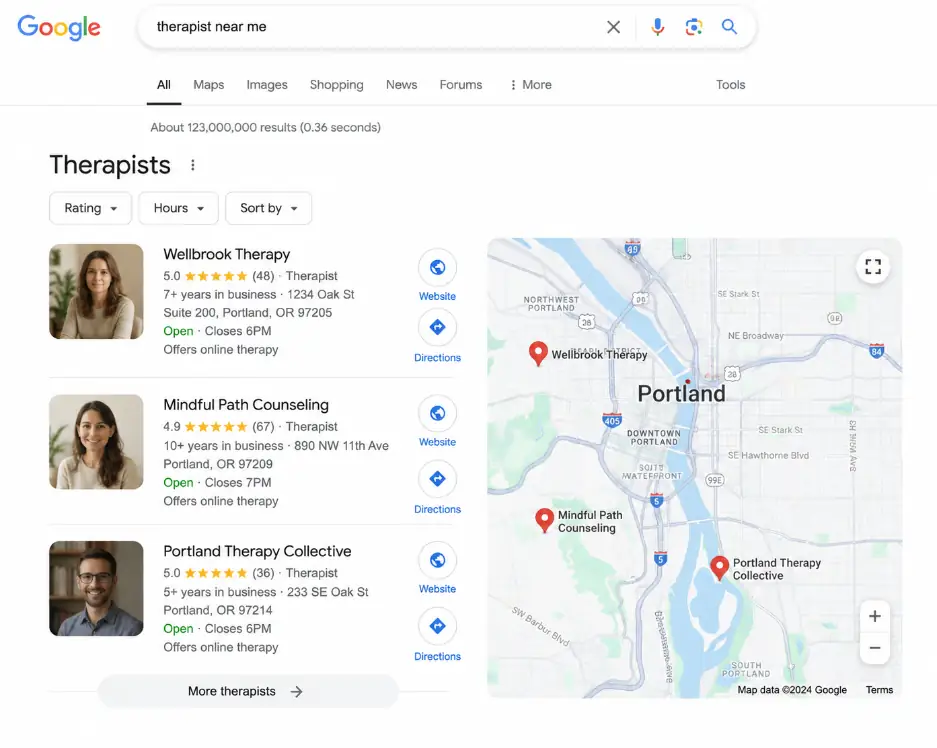
For brick-and-mortar clinics and telehealth providers targeting specific geographic regions, capturing local search intent drives the highest volume of qualified inquiries. When a prospective client searches for "therapist near me" or "anxiety counselor in [City]," Google relies heavily on the map pack to deliver results. Securing a position in these top three local listings requires aggressive local SEO for counseling practices.
Your primary asset in this arena is your Google Business Profile (GBP). Optimizing Google Business Profile for clinicians involves far more than simply claiming your listing and entering your address. You must populate every available field with accurate, comprehensive data. Begin with the Name, Address, and Phone number (NAP). This information must remain perfectly consistent across your GBP, your website, and all external directories. Even minor discrepancies, such as using "Ste." on your website and "Suite" on your GBP, degrade Google's trust in your data and lower your local ranking.
Select the most accurate primary category for your business, such as "Psychotherapist," "Mental Health Clinic," or "Marriage or Relationship Counselor." Add relevant secondary categories to broaden your visibility. Maximize the "Services" section by listing your specific modalities and treatment areas. Include high-quality, professional photographs of your office exterior, waiting room, and therapy spaces. These images perform a crucial psychological function: they demystify the clinical environment, reducing the anticipatory anxiety a new client feels before their first appointment. For a complete, step-by-step methodology to dominate the local map pack, prioritize optimizing your Google Business Profile for therapists.
Telehealth-only practices must navigate GBP rules carefully. Google requires a physical location to display a pin on the map. If you operate entirely virtually from a home office, you must hide your address and configure your profile as a Service Area Business (SAB), selecting the specific cities or zip codes where you hold licensure and accept patients.
Reviews present a unique challenge in local SEO for therapists. While standard businesses rely on acquiring hundreds of Google reviews to boost their local rankings, mental health professionals face strict ethical guidelines regarding patient testimonials. You cannot solicit reviews from current clients. To build authority ethically, request reviews from professional colleagues, clinical supervisors, or referral partners who can attest to your professional character, continuing education efforts, and clinical acumen without violating patient confidentiality.

Search Engine Optimization represents the most reliable, high-yield strategy for sustainable private practice growth. While paid advertising provides immediate visibility, it operates on a pay-to-play model. SEO builds permanent digital equity. When evaluating psychology directory vs search engine visibility, consider the user experience. Directories list you alongside dozens of direct competitors, forcing clients to make decisions based on superficial factors like headshots and hourly rates. Ranking your own website organically allows you to monopolize the client's attention, presenting your unique clinical value without distraction.
Effective comprehensive SEO for therapists requires a multi-layered approach encompassing technical SEO, on-page optimization, and off-page authority building. Technical SEO ensures search engine crawlers can index your site efficiently. This includes securing your site with HTTPS, fixing broken links, optimizing image alt-text, and implementing a logical URL architecture.
A critical, often overlooked technical component is schema markup for healthcare practices. Schema is a specialized code added to your website that translates your content into a language search engines natively understand. By utilizing MedicalClinic, Physician, or HealthAndBeautyBusiness schema, you explicitly define your exact geolocation, accepted insurance providers, clinical specialties, and credentialing. This structured data gives search engines the absolute certainty they require to rank your practice above competitors who rely on standard text alone.
On-page SEO revolves around keyword strategy. Avoid competing for hyper-competitive, broad terms like "therapy." Instead, target long-tail keywords that signal high commercial intent. A user searching for "EMDR therapy for complex PTSD in Dallas" possesses a clear understanding of their needs and is ready to book an intake. Map these targeted keywords to specific pages on your website. Place your primary keyword in the URL slug, the H1 title tag, the meta description, and naturally throughout the body text.
Off-page SEO focuses on building domain authority through backlinks. Search engines view links from other reputable websites to your site as votes of confidence. Earning links from high-authority healthcare domains, local community organizations, and regional news outlets signals that your practice represents a trusted local institution.

Social media platforms offer immense potential for building brand awareness and humanizing your practice, provided you navigate the environment with strict adherence to professional boundaries. Social media marketing is not about generating direct appointment bookings from viral posts; it functions as a highly effective tool for establishing clinical authority, distributing educational content, and building trust signals with a broader audience.
Choosing the appropriate platform depends entirely on your established niche. If you provide specialized services for adolescents, neurodivergent individuals, or young adults managing anxiety, platforms like Instagram and TikTok align perfectly with your demographic. Conversely, if your practice focuses on executive burnout, leadership coaching, or providing clinical consulting to other professionals, LinkedIn represents the optimal environment to build your presence.
Maintaining social media ethics for social workers, psychologists, and counselors requires absolute vigilance. The parasocial relationships formed on social media blur the lines between clinical advice and public education. Every piece of content must carry clear disclaimers stating that the information provided serves educational purposes only and does not constitute a therapeutic relationship. You must strictly avoid diagnosing public figures, commenting on specific client cases (even if anonymized), or engaging in public debates that compromise your professional standing.
Develop a content strategy built on established pillars. Share psychoeducational content that explains complex clinical concepts in accessible language. Break down the mechanics of the nervous system, explain the function of specific coping strategies, or debunk common myths regarding mental health treatment. Share behind-the-scenes glimpses of your practice, such as your therapy room setup or your professional development activities, to build familiarity. Consistency outranks frequency. Committing to two high-quality, clinically accurate posts per week yields better long-term engagement than posting generic, low-effort content daily.
Content marketing for behavioral health establishes you as the premier authority in your specialized field. When a prospective client searches for answers to their mental health struggles, they want guidance from an expert. By publishing comprehensive, empathetic, and scientifically accurate content, you provide immense value before a financial transaction ever occurs. This process builds a deep reservoir of trust, drastically increasing the likelihood that the reader will choose your practice when they are ready to begin therapy.
A well-structured blog acts as a powerful engine for organic traffic. Address the specific questions your ideal clients type into Google. Topics like "How to support a partner with severe social anxiety" or "Understanding the difference between ADHD paralysis and depression" capture high-intent search traffic. To maximize the effectiveness of your writing, you must learn the SEO game in 5 easy steps, ensuring your articles are properly formatted with H2 and H3 subheadings, optimized meta descriptions, and clear internal linking structures. Every blog post must culminate in a direct, relevant call to action, guiding the reader to book a consultation or read a related service page.
Video content accelerates the rapport-building process. Therapy requires a high degree of vulnerability, and clients want to know exactly who they will be speaking with before they commit. Video allows prospective clients to observe your body language, hear your tone of voice, and gauge your demeanor.
Writing effective video scripts requires brevity and clarity. Hook the viewer within the first three seconds by identifying their specific problem. Validate their experience, provide one actionable piece of psychoeducation or a practical coping mechanism, and close with a clear invitation to connect with your practice. Embed these videos directly onto your website's service pages and distribute them across your social media channels to maximize their reach and impact. Consistently answering the question of how to get more therapy clients relies heavily on your ability to produce content that proves your competence unconditionally.
While digital visibility dominates modern patient acquisition, building a clinical referral network remains a highly lucrative, highly stable pillar of private practice growth. Digital marketing captures clients actively searching for therapy, while a strategic referral network captures clients who disclose their struggles to other trusted professionals in their lives.
Stop viewing other therapists as competitors. An established clinician with a full caseload represents one of your best sources for new clients. Generalist therapists frequently encounter cases that exceed their scope of practice and require specialized intervention. If you hold specialized training in eating disorders, somatic therapy, or specialized trauma modalities, position yourself as the premier destination for these complex cases.
Expand your networking efforts to include collateral healthcare providers and community professionals. A pediatric therapist should build deep relationships with local pediatricians, school guidance counselors, and child psychiatrists. A couples counselor should network with family law attorneys and divorce mediators. These professionals constantly interact with individuals experiencing acute distress who desperately need mental health support.
Outreach must be proactive, professional, and entirely focused on mutual patient benefit. Do not send generic, mass emails. Identify specific practitioners in your area, research their patient populations, and send a highly targeted message.
Use this exact 3-sentence outreach email template:
"Hi Dr. [Last Name], I am a licensed psychotherapist specializing in [Your Specific Niche] and I deeply respect your approach to patient care at [Their Practice Name]. I am currently accepting new referrals and would love to schedule a brief 10-minute phone call to learn more about your patient population and discuss how we can collaboratively support complex cases in our community. Please let me know if you have a brief window of availability next Tuesday or Thursday."
Follow up consistently. A single email rarely generates a partnership. Schedule quarterly check-ins, send relevant clinical articles, and always express profound gratitude when a provider trusts you enough to refer a patient to your practice.
Email marketing in the behavioral health sector requires a delicate balance of providing ongoing value while strictly maintaining professional boundaries. Unlike retail businesses that use email to push flash sales and aggressive promotions, therapists use email to nurture relationships, maintain top-of-mind awareness, and support client retention between scheduled sessions.
Your email list should consist strictly of individuals who have explicitly opted in to receive communication from your practice. This includes current clients (who have signed appropriate consent forms), past clients, professional colleagues, and website visitors who downloaded a free resource, such as a grounding technique worksheet or a nervous system regulation checklist.
Send a monthly or bi-weekly newsletter that reinforces the therapeutic work done in your office. Share curated resources, such as book recommendations, links to your latest blog posts, podcast episodes, or practical mindfulness exercises. When a past client experiences a new stressor or a symptom relapse, your practice is the first one they call. Not because you advertised, but because your name stayed present.
When past clients experience a new stressor or a relapse in symptoms, your practice will be the first one they contact because your name consistently appears in their inbox providing helpful, non-intrusive support. Ensure your email marketing platform complies fully with privacy regulations, utilizing systems that offer robust data protection and explicit subscriber management controls.

The landscape of digital search is undergoing a massive paradigm shift. Prospective clients no longer rely exclusively on traditional Google searches yielding a list of blue links. They now use Large Language Models (LLMs) like ChatGPT, Perplexity, and Google's AI Overviews to ask complex, conversational questions. A user will type, "Find me a licensed therapist in Austin who specializes in EMDR for veterans, takes Blue Cross insurance, and has a calming demeanor." If your digital presence is not optimized for AI retrieval, you will vanish from these critical search results.
Generative Engine Optimization for clinicians represents the absolute frontier of modern marketing. AI models do not "search" the internet in real-time the way traditional algorithms do; they synthesize information based on the data they ingested during their training phases and verify facts through real-time web crawling of highly trusted sources. To be recommended by an AI, your practice must demonstrate overwhelming digital consensus.
Concrete actions drive AI visibility. First, you must saturate the directories AI crawls. LLMs cross-reference data across major platforms to verify your existence and credibility. Ensure your practice information is identical across Psychology Today, Healthgrades, WebMD, local Chamber of Commerce listings, and specialized clinical directories. Second, implement comprehensive schema markup. AI systems parse structured data significantly faster than plain text. If your schema explicitly details your credentials, accepted insurances, and modalities, the AI extracts this data instantly to answer specific user queries.
Third, create deep, rich FAQ content. AI models consume question-and-answer formats highly effectively. Build dedicated pages answering highly specific questions related to your niche. Address the exact logistics of your treatment process, pricing models, and clinical philosophies.
Most practices are not yet optimized for AI search, which means the window to establish early authority is still open. Premark Lab's GEO for therapists service is built around exactly this shift: directory saturation, structured schema, and FAQ content architecture designed to surface your practice as the consensus answer in AI-generated results. This is not a future concern. It is where a meaningful share of your next ten clients will find you.
Marketing a private practice requires navigating a complex web of ethical guidelines and federal regulations. Standard digital marketing tactics utilized by e-commerce brands or local service businesses often violate the codes of conduct established by governing bodies such as the American Psychological Association (APA), the National Association of Social Workers (NASW), and the American Counseling Association (ACA). Ignorance of these rules does not protect your license.
The prohibition of testimonials stands as a major differentiator in therapy marketing. You cannot solicit reviews, testimonials, or endorsements from current clients or former clients who are vulnerable to undue influence. Your marketing materials must rely entirely on highlighting your clinical expertise, educational background, and therapeutic modalities rather than leveraging the outcomes of past patients.
Furthermore, all marketing copy must strictly avoid outcome guarantees. You cannot state, "I will cure your depression in ten sessions," or "Our practice guarantees an end to your panic attacks." Such statements are ethically prohibited and legally actionable. Use precise, clinical language. State that you "treat," "support," "manage," or "provide evidence-based interventions for" specific conditions. Your copy should inspire hope through competence, not through empty promises.
HIPAA compliant digital marketing forms the baseline of your digital infrastructure. Patient privacy extends far beyond the therapy room; it governs how your website processes data. Standard contact forms that send unencrypted data to a generic Gmail address constitute a severe HIPAA violation. You must utilize encrypted, secure forms integrated directly into a compliant Electronic Health Record (EHR) system. If you utilize Google Workspace for email or analytics tools to track website traffic, you must execute a Business Associate Agreement (BAA) with these technology providers. Safeguarding protected health information (PHI) remains your ultimate responsibility, and your marketing ecosystem must reflect this commitment unequivocally.
How much should therapists budget for marketing? Most practices in growth mode allocate seven to ten percent of projected gross revenue. On a practical level: if a single client generates $2,000 across their treatment course, spending $200 to acquire them is a sound return. Prioritize foundational assets — website optimization and local SEO — first. These lower your acquisition cost over time rather than resetting to zero the moment you stop paying.
Is advertising ethical for therapists? Yes, with clear guardrails. APA, NASW, and ACA ethics codes permit advertising provided it is truthful, avoids false claims, and never guarantees clinical outcomes. You cannot solicit testimonials from current clients or recently discharged clients who remain vulnerable to undue influence. What you can do is accurately market your credentials, modalities, and clinical focus. Ethical advertising informs a prospective client — it does not pressure them.
How long does SEO take for a therapy practice? A fully optimized site typically takes 90 to 120 days to begin ranking competitively in local search. Established domains with existing authority move faster. Each published, keyword-targeted article compounds over time — a post written today still earns traffic two years from now. Paid ads deliver immediate traffic but stop the moment your budget does. SEO starts slower and runs indefinitely once it gains traction.
Which social media platform is best for therapists? It depends on your niche and ideal client. Instagram and TikTok reach adults 18–35 managing anxiety, identity issues, and relationship stress. LinkedIn is most effective for therapists targeting executives, professionals, or building referral relationships with other providers. If no platform energizes you, a well-optimized website and a strong referral network will outperform inconsistent social presence every time.
Should I hire a marketing agency or DIY my marketing? DIY is viable early on. Claiming your Google Business Profile, writing service pages, and publishing blog posts are all learnable. The constraint is time. Most therapists cannot sustainably manage SEO, content, GBP optimization, and AI search visibility alongside a full caseload and a paperwork. A specialized agency that works exclusively with private practices will compress your results timeline and keep you in the clinical chair. A generalist agency will not.
Transforming your private practice requires a structured, aggressive approach. Sporadic marketing efforts yield zero results. Execute this precise ninety-day action plan to establish dominance in your local or specialized clinical market.
Month 1: Foundation and Positioning Audit your clinical strengths and define a hyper-specific niche. Eliminate generalist language from all your materials. Overhaul your website architecture, ensuring mobile optimization, rapid page speed, and clear, authoritative copywriting. Claim and verify your Google Business Profile, populating every field meticulously with consistent NAP data, comprehensive service descriptions, and professional photography of your clinical space.
Month 2: Content and Connection Launch your SEO and content strategy. Identify five high-intent, long-tail keywords relevant to your specialization. Publish comprehensive, structurally optimized service pages for each keyword. Implement exact schema markup on your website to explicitly define your healthcare credentials to search engines. Simultaneously, initiate your referral network strategy. Send the targeted outreach email template to ten aligned local professionals (psychiatrists, dietitians, or family lawyers) to schedule initial introductory calls.
Month 3: Advanced Visibility and Analytics Expand your digital footprint by addressing AI search optimization. Ensure your practice details are flawlessly consistent across all major clinical directories to build the consensus LLMs require. Record and embed short, professionally lit video introductions on your core service pages. Implement HIPAA-compliant analytics to measure exactly where your intake requests originate, allowing you to double down on the highest-converting channels.
Scaling a specialized clinical practice requires moving beyond passive referrals and mastering the mechanics of modern digital visibility. You do not need to navigate complex search algorithms, AI optimization, and technical website architecture alone. Visit the Premark Lab Specialty Index or schedule a free consultation today to align your clinical expertise with elite, data-driven growth strategies.
Tracking your marketing efforts is key to understanding their effectiveness. Utilize analytics tools to gather data. These insights help refine your strategies over time.