.png)
For a private practice, local SEO comes down to one thing: showing up when someone in your area goes looking for a therapist. The work has five parts: a claimed and complete Google Business Profile, consistent name-address-phone data everywhere, city and specialty service pages on your website, ethical review handling, and content that answers the questions clients actually type.
Most therapy practices lose search visibility for boring, fixable reasons. A profile that lists the wrong hours, a website with one thin "Services" page, an old address still floating around in three directories.
A therapy practice website has one job: turn a stranger's search into a booked consultation. Everything else is decoration.
Search behaviour for mental health services is intensely local and intensely specific. Someone looking for help with panic attacks in Portland doesn't want a national directory. They want a licensed therapist within driving distance who takes their insurance and has openings this month.
Google knows that, which is why the map pack sits above the organic results for almost every therapy-related query with local intent. Winning that space is what local SEO for therapists is really about.
This guide walks through the whole system: profile optimization, citations, on-page work, content strategy, tracking, and the ethical constraints that make SEO for therapists different from SEO for plumbers.
.webp)
Search engine optimization is the practice of making a website easier for search engines to find, understand, and recommend. For a therapy practice, the goal narrows: be the obvious answer when someone within a reasonable drive searches for the kind of help you provide.
Referral networks are unpredictable. A single retiring physician or a psychiatrist who moves practices can cut your intake volume in half, and nothing about that is under your control.
Search traffic behaves differently. A page that ranks for "grief counseling Sacramento" keeps producing inquiries month after month with no ongoing spend, and the people who find it are already looking for exactly what you offer.
Directory listings help, but they rent you visibility rather than sell it. Psychology Today sends real clients, and it also puts your listing next to forty competitors on the same results page.
A website you own removes that competition from the frame. When someone lands on your practice site from Google search, the only clinician being evaluated is you.
Traffic is the wrong goal. A therapy practice with a full caseload doesn't need ten thousand visitors, it needs eight to fifteen qualified inquiries a month from people in the right geography with the right presenting concerns.
Set goals around inquiries, not rankings. Count the form submissions and phone calls that organic search brings in each month, then trace each one back to the page and the search term behind it.
A realistic first-year target for a solo practice: rank in the top three map results for your city plus your two strongest specialties, and hold page-one organic positions for six to twelve long-tail terms.
Group practices should aim wider. Each clinician's specialty becomes its own keyword cluster, and each office location becomes its own set of local service pages.
The strategy below runs in order because each step depends on the one before it. Fixing your website before fixing your Google Business Profile wastes the easier win.
Every SEO strategy rests on four pillars, and neglecting one caps the return on the other three.
Therapists usually over-invest in the third pillar and ignore the first. A beautifully written article on a website that takes nine seconds to load will lose to a mediocre article on a fast one.
Cost per inquiry drops over time. Paid ads stop producing the moment the budget stops, while a ranking page keeps working.
Client fit improves. Someone who found you through a page about perinatal mental health arrives already understanding your focus, which shortens the consultation and reduces early dropout.
Referral partners check you out online before sending anyone. A practice website that ranks well and reads professionally makes those referrals easier to earn.
Insurance panels, supervision opportunities, and speaking invitations tend to follow visibility. Being findable compounds in ways that are hard to predict in advance.
Local SEO fits any practice that serves clients from a defined geographic area. Solo practitioners, group practices, and clinics all qualify.
Fully virtual practices sit in a grey zone. A therapist licensed in three states can still build state-level and city-level pages, though without a physical address the map pack is largely closed off.
Practices with a physical office have the strongest case. Google's local ranking factors weight proximity heavily, which means a small practice can outrank a large one for searches originating a few blocks away.
Claim and verify the profile first at Google Business Profile. Verification usually happens by postcard or video, and nothing else in local search matters until it's done.
Set the primary category with care. Google treats "Psychotherapist," "Mental Health Clinic," "Family Counselor," and "Psychologist" as separate categories that each get pulled into different searches, so choose the label a client would use for the work you do.
Add secondary categories for genuine services only. A profile stuffed with unrelated categories dilutes relevance rather than expanding it.
Fill in every field: hours, service area, appointment link, phone, and a description that names your specialties and city in plain language. Google's guidelines for representing your business spell out what is and isn't allowed.
Upload real photos of the office exterior, waiting room, and therapy room. Profiles with photos get meaningfully more direction requests and calls than profiles without them.
Post updates monthly. A short post about a new group starting, a workshop, or seasonal availability keeps the profile active and gives Google fresh signals.
If you practice from home or prefer not to publish your address, configure the profile as a service-area business and hide the street address. Hiding it is permitted; faking a location is not, and Google removes profiles for it.
.webp)
NAP stands for name, address, and phone number. Search engines cross-reference those three data points across the web to confirm your practice is real and located where you say it is.
Inconsistency creates doubt. "Riverside Counseling, LLC" on your website, "Riverside Counseling" on Psychology Today, and "Riverside Counselling" on an old Yelp listing read as three possible entities to a crawler.
Write your NAP once in a canonical format, then propagate it exactly. Suite numbers, abbreviations, and phone formatting all count.
Audit the obvious places first: Psychology Today, Yelp, Apple Maps, Bing Places, TherapyDen, GoodTherapy, your state licensing board directory, and any insurance panel directories listing you.
Old addresses are the most common problem in therapy practices. Clinicians move offices every few years, and the previous address lingers in directories nobody remembers creating.
Steps 3 through 6 get their own sections below: service and city pages under website implementation, content strategy under local content, and measurement under tracking.
Ninety days is enough to complete the foundational work and see early movement in impressions. Rankings for competitive terms take longer.
Days 1 to 30: claim and fully optimize the Google Business Profile, audit and correct NAP data across the top fifteen directories, install Google Search Console and Google Analytics, and fix any page loading slower than three seconds.
Days 31 to 60: build one service page per specialty you actually want more of, write a genuinely useful About page with credentials, add a fees and insurance page, and create your primary city page.
Days 61 to 90: publish four local blog posts, request reviews from appropriate sources within ethical limits, earn two or three local backlinks, and review Search Console data for terms you rank for on page two.
Page-two keywords are the highest-leverage thing you'll find in that final review. Moving a term from position 14 to position 8 often takes one improved page rather than three months of new work.
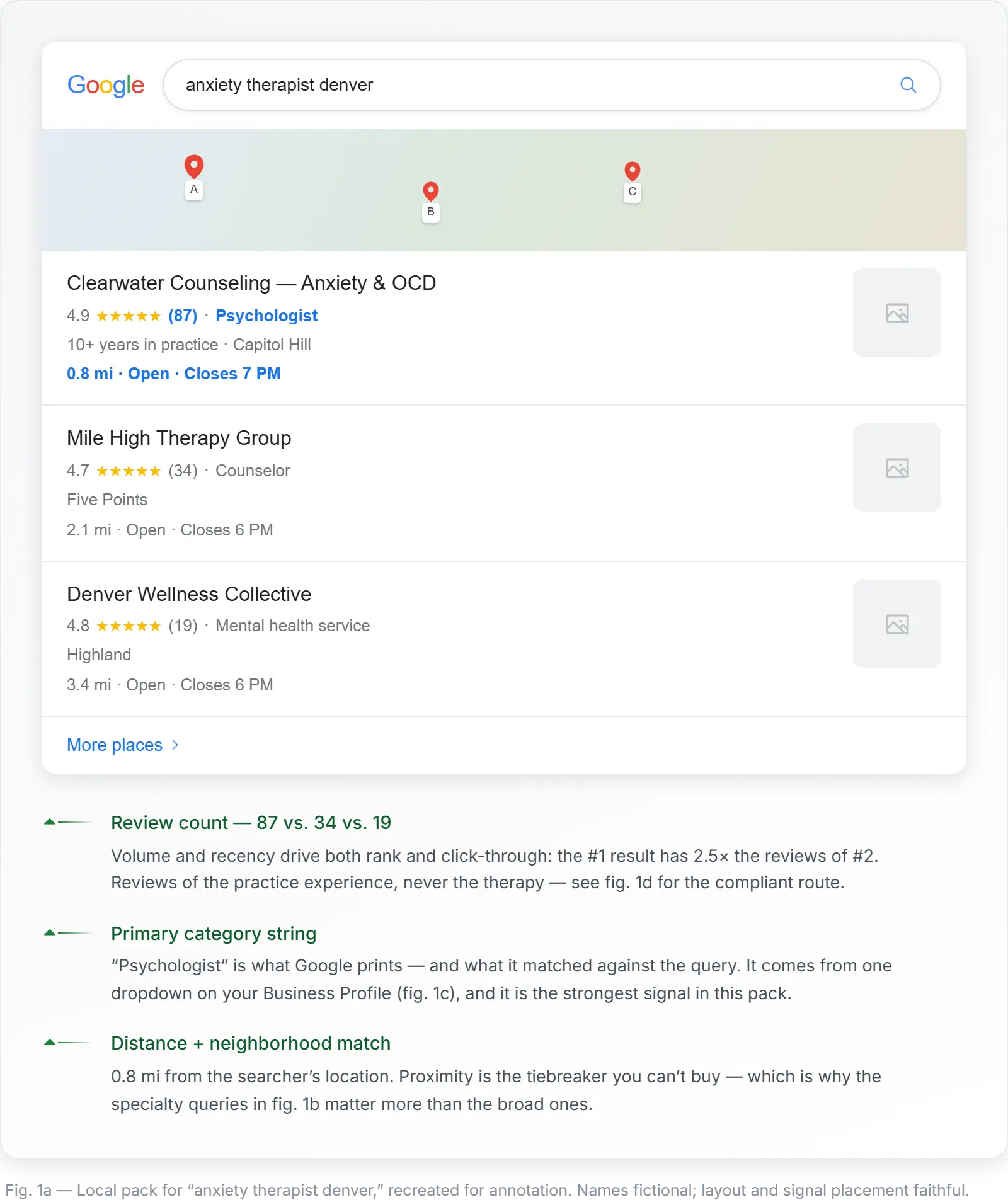
The roadmap above assumes a practice with capacity to fill. A therapist with a waitlist and no plans to expand gets little from this work beyond insurance against future slow periods.
In a competitive metro, expect the timeline to stretch and keep your keyword focus tight. Competing for "therapist Chicago" is unrealistic for a solo clinician; competing for "ADHD therapist Logan Square" is very achievable.
Newly licensed therapists benefit most. Without an established referral network, search is often the fastest path to a first full caseload.
Your website is the only asset in this system you fully control. Directory profiles can be changed or removed by the platform; your site cannot.
One page, one topic, one primary keyword. A page trying to rank for anxiety, depression, and couples counseling simultaneously ranks well for none of them.
Put the target keyword in the title tag, the H1, the first hundred words, and at least one subheading. Natural placement beats forced repetition, and search engines have understood synonyms for years.
Write title tags between 50 and 60 characters. "Anxiety Therapy in Asheville, NC | Riverside Counseling" tells both Google and the human scanning results exactly what the page offers.
Meta descriptions don't affect rankings directly. They do affect click-through rate, which is worth the two minutes per page it takes to write one.
Use descriptive image filenames and alt text. "waiting-room-riverside-counseling-asheville.jpg" carries information that "IMG_4471.jpg" does not.
Keep URLs short and readable. A URL like /anxiety-therapy-asheville outperforms /services/mental-health/individual/anxiety-treatment-options.
A practice website needs fewer pages than most therapists assume, but each one has to be substantial.
Each service page should run 800 to 1,500 words and cover symptoms, your treatment approach, what a first session looks like, and cost. Thin pages of 200 words rarely rank for anything competitive.
Technical SEO for a small practice website is a short list, not a career. Run through the following once, then check quarterly.
Form compliance deserves emphasis. A standard contact form that asks about symptoms may create protected health information, and the HHS guidance for HIPAA-covered professionals is the primary source to check before building one.
Google ranks local results on three factors it states publicly: relevance, distance, and prominence. Relevance and prominence are the two you can influence.
Relevance comes from category selection, profile completeness, and website content matching the query. A practice with a page specifically about postpartum depression will beat a generic practice for that search even from further away.
Prominence comes from reviews, citations, backlinks, and general web presence. Google's own documentation on improving local ranking confirms review count and score feed into it.
Distance is fixed unless you open another office. Practices in dense areas should focus on neighbourhood-level terms rather than fighting for city-wide visibility.
Doing the work yourself is realistic for a solo practice and costs roughly four to six hours a month after the initial setup. The setup itself runs twenty to thirty hours spread over the first two months.
The skills required are ordinary: writing clearly, editing a website, and reading a dashboard. No coding is needed on Squarespace, Wix, or a standard WordPress theme.
Where self-implementation breaks down is consistency. Local SEO rewards steady monthly attention, and clinical work reliably crowds out marketing work when caseloads get heavy.
Hiring help makes sense when your time is worth more than the fee. A therapist billing $150 an hour who spends six hours monthly on SEO is spending $900 in opportunity cost, which buys a competent contractor.
The four tactics below deliver most of the results in local search for therapy practices. Everything else is refinement.
The Google Business Profile outranks your website for branded searches and controls whether you appear in the map pack at all. Treating it as a set-and-forget listing wastes the strongest tool available.
Answer the Q&A section yourself. You can post your own questions and answers, which lets you address "do you take Aetna?" or "is there parking?" before a client has to ask.
Use the Services section to list each specialty with a short description. Those entries give Google explicit signals about what you treat.
Enable messaging only if you can respond within a day. Slow response times are visible to users and reflect badly on the practice.
Consistent NAP data is the cheapest trust signal available. Spend one afternoon working through your listings and you'll prevent a whole class of ranking problems that would otherwise stay invisible.
Search your practice name and phone number in quotes on Google to surface listings you forgot about. Old profiles from previous group practices show up constantly this way.
Update the phone number last if you're changing it. Every directory needs the new one, and a stale number in a high-authority listing sends calls into a void.
Not all therapy directories are equal. The comparison below reflects what each platform actually delivers.
Treat directories as a citation layer plus a secondary lead source. The backlink and NAP consistency they provide support your website's rankings even when the listing itself sends few clients.
A local service page combines one service with one place: “Trauma Therapy in Ann Arbor,” not “Our Services.”
Each page needs genuine local content. Mention the neighbourhoods you serve, parking and transit details, local referral partners, and community resources relevant to that concern.
Never duplicate a page and swap the city name. Google identifies templated location pages easily, and they either fail to rank or get filtered out entirely.
Build these pages only for places you can defend. A practice in Boise creating a page for Salt Lake City with no presence there is building something that will never rank and may damage site quality signals.
Mental health searches carry unusually high intent. Someone typing "therapist accepting new clients near me" is not browsing, they're ready to act.
Capturing that moment is worth more than a hundred general visitors. A single client in weekly therapy for a year represents several thousand dollars of revenue, which changes the maths on what local search visibility is worth.
The competitive field is also weaker than in most industries. Many therapy websites are years out of date, which means basic optimization work still produces outsized results.
Once your practice name is covered, what you publish is what earns the rest of your rankings. The strategy below organizes writing so each piece supports the others.
A topic cluster pairs one broad pillar page with several narrow supporting pages, all linked together. The structure tells search engines your website covers a subject thoroughly rather than superficially.
Example cluster for a trauma-focused practice: the pillar is "Trauma Therapy in Portland," and supporting pages cover EMDR, complex PTSD, first responder trauma, somatic approaches, and what to expect in a first trauma session.
Each supporting page targets a long-tail keyword and links up to the pillar. The pillar links down to every supporting page.
Specialty depth beats breadth. "Therapist near me" attracts high volume and low conversion, while "EMDR therapist for first responders Portland" attracts few searches and books nearly all of them.
Generic mental health articles compete with WebMD and lose. Local angles have almost no competition.
Cost and insurance topics perform disproportionately well. Prospective clients search those terms constantly, and most practices refuse to publish the answers.
Write for the person deciding whether to call, not for other clinicians. Jargon-heavy posts about theoretical orientation attract colleagues rather than clients.
A curated resource page listing local crisis lines, support groups, psychiatrists, and sliding-scale clinics serves clients and earns links at the same time.
Organizations you list often link back once they notice. Local nonprofits, community centres, and university counseling services all maintain resource pages of their own.
Keep the page current. A crisis line that changed numbers eighteen months ago undermines every trust signal the page was built to create.
Internal links distribute authority through your website and help search engines understand relationships between pages. Every blog post should link to at least one service page.
Use descriptive anchor text. A link reading "anxiety therapy in Asheville" carries more information than one reading "click here."
Link service pages to each other where clinically sensible. A page on couples counseling can reasonably link to one on communication and one on family therapy.
Keep important pages within three clicks of the homepage. Pages buried deeper get crawled less often and rank worse.
Measurement separates a strategy from a hobby. Without data, you cannot tell whether last quarter's work produced anything.
Search Console is the tool worth learning properly. The Queries report reveals keywords you rank for without knowing it, which is the fastest source of content ideas available.
Review these on the same day each month. Comparing week to week produces noise that leads to bad decisions.
High impressions with low clicks means Google shows your page but nobody chooses it. The cause is almost always the title tag, the meta description, or a ranking position too low to attract clicks.
Check position first. A page averaging position 15 with thousands of impressions has a ranking problem, not a copywriting problem.
A page in the top five with a poor click-through rate has a messaging problem. Rewrite the title to name the city and the specific benefit, then check again in three weeks.
Work through the list in order. Each item is a discrete task you can finish in one sitting.
Most solo therapy practices should budget $500 to $1,500 per month for ongoing local SEO services, or $1,500 to $5,000 for a one-time setup they then maintain themselves. Group practices with multiple locations run $2,000 to $5,000 monthly.
Anything under $300 a month is usually automated directory submissions with no real strategy behind it. Anything over $5,000 for a single-location practice is priced for a market you aren't in.
Doing the work yourself costs nothing but time: roughly thirty hours of setup and five hours a month afterwards. The choice comes down to your hourly billing rate against the contractor's fee.
The 80/20 rule in SEO means roughly 80 percent of your results come from 20 percent of your pages and effort. In a therapy practice, that small slice almost always turns out to be the Google Business Profile alongside a couple of specialty service pages.
Check your own data before assuming which pages qualify. Search Console will show a handful of URLs producing most organic clicks, and those are the pages worth improving.
Applying the rule means resisting the urge to publish forty blog posts. Making five pages excellent outperforms making forty pages adequate.
The highest-return channels for therapists are Google Business Profile, Psychology Today, your own website, and local professional referral relationships. Paid options include Google Ads and, with careful targeting, Meta ads.
Meta advertising carries specific risk for mental health services. Platform policies restrict targeting based on inferred health conditions, and ad accounts get restricted for copy implying knowledge of a user's mental state.
Community channels convert unusually well. Guest talks at libraries, workshops for local employers, and articles in neighbourhood publications generate both clients and local backlinks.
Skip any service promising guaranteed first-page rankings. Nobody can guarantee positions in Google search, and the tactics used to fake it get websites penalized.
SEO matters for therapists because therapy is a local, high-intent, high-value service where clients search privately before they ever ask a person for a recommendation. Search is often the only channel where a stranger in distress can find you.
Privacy drives the behaviour. Someone struggling with an eating disorder or an affair is far more likely to open a search bar than to ask a friend for a referral.
Client lifetime value makes the maths work. One client attending weekly sessions for a year is worth several thousand dollars, so even modest visibility gains pay for the effort many times over.
Trust in Google's quality framework means evidence that your website is accurate, transparent, and safe to rely on, and it is the central element of E-E-A-T: experience, expertise, authoritativeness, and trustworthiness. Mental health content sits in the "Your Money or Your Life" category, where Google's raters apply the strictest standards.
Signal trust with specifics. Full name, credentials, license type and state, degree, training certifications, and years in practice all belong on your About page and in an author byline on every article.
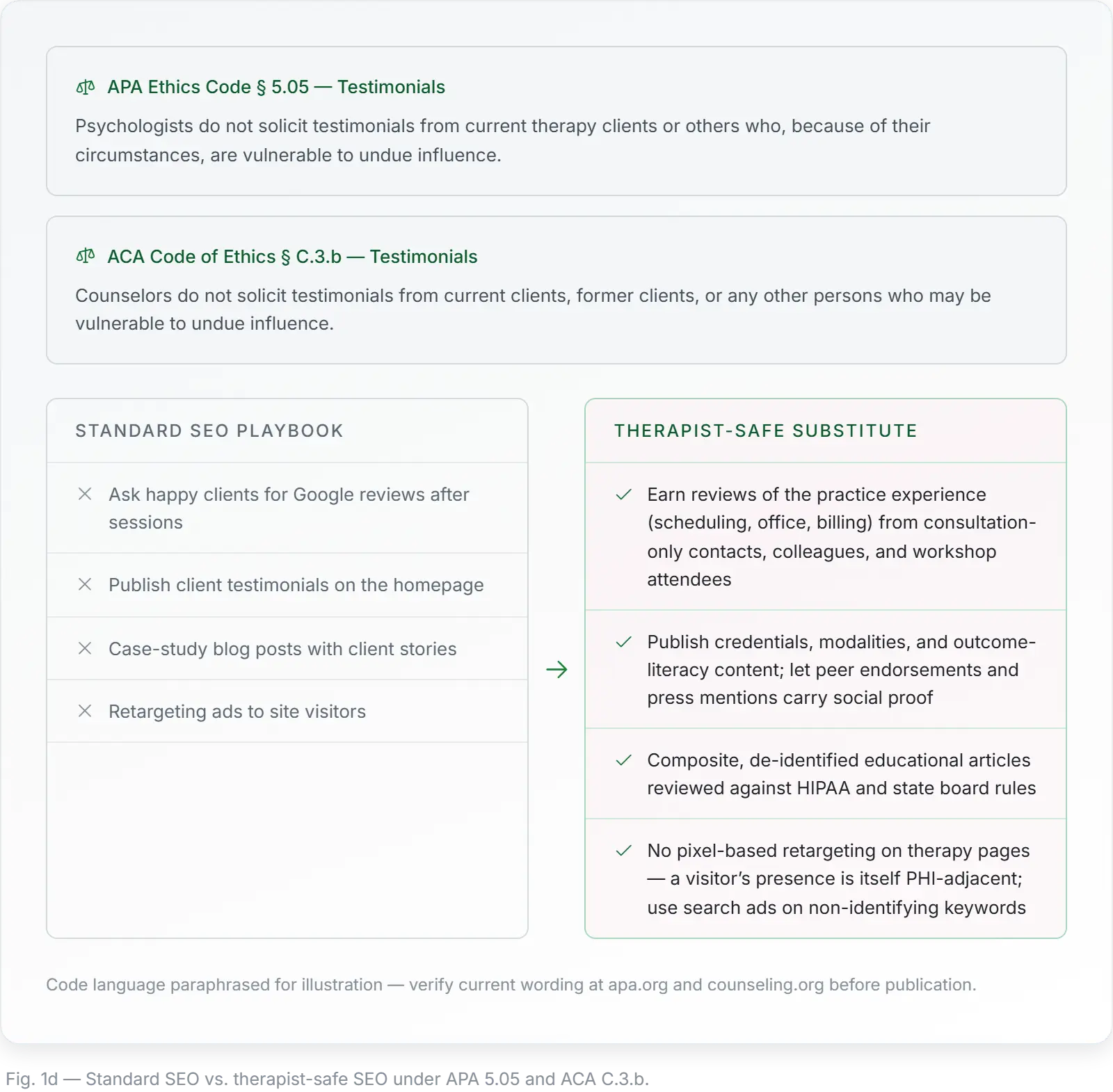
Reviews are a trust signal with an ethical constraint attached. APA Standard 5.05 prohibits soliciting testimonials from current therapy clients or others vulnerable to undue influence, and ACA Standard C.3.b applies comparable restrictions to counselors.
Working within those limits is possible. Ask for reviews from colleagues who have referred to you, supervisees, workshop attendees, and consultation clients rather than from people in active treatment.
Responding to reviews carries a separate hazard. Confirming that a reviewer was a client, even to defend yourself, discloses protected health information, and OCR has penalized practices for exactly that. Respond with a generic statement about privacy policies and nothing more.
Google's own guidance on creating helpful content describes what its systems reward, and it maps closely onto what an ethical practice would publish anyway.
Address search intent by matching your page format to what the searcher wants to do, which falls into four types: informational, navigational, commercial, and transactional. Search the target keyword yourself and study what already ranks.
Informational queries like "signs of postpartum depression" need an educational article. A service page will not rank for that term regardless of how well it's optimized.
Commercial queries like "best trauma therapist in Denver" need comparison-style content or a strong service page with credentials, approach, and pricing.
Transactional queries like "book therapy appointment Denver" need a page with obvious scheduling. Any friction between the click and the booking loses the client.
Intent mismatches explain most ranking failures. A page that will not rank after six months of link building usually has the wrong format for the query, not too few backlinks.
Optimize for AI search by writing self-contained, factually precise passages that an assistant can lift and cite without needing surrounding context. AI Overviews, ChatGPT, and Perplexity all extract chunks rather than whole pages, which is why generative engine optimization is becoming its own discipline.
Answer the question in the first sentence under each heading, then explain. Assistants pull the opening sentence far more often than anything buried in paragraph four.
Avoid ambiguous pronouns at the start of paragraphs. A paragraph beginning "This means..." becomes meaningless once separated from what came before it.
Use specific headings that describe their content exactly. "How Much Therapy Costs in Austin" gets extracted; "Overview" does not.
Add structured data and keep facts current with visible dates. Assistants weight recency and verifiable specifics heavily when deciding which source to cite.
Lists and clearly labelled comparisons get pulled more often than dense prose. Format any process as a numbered list and any comparison as a labelled set of options.
Local SEO for therapists is not complicated, though it is cumulative. The practices that win are the ones that fix the Google Business Profile properly, publish real service pages, and keep going for a year while competitors stop after six weeks.
Start with the profile. Nothing else on the list produces results as quickly or costs as little.
Build the website pages next, one specialty at a time, and make each one genuinely useful to someone deciding whether to call. Depth on three pages beats thin coverage across fifteen.
Track what happens in Search Console every month, improve the pages sitting on page two, and let the compound effect do its work. A therapy practice that is easy to find, clear about what it treats, and transparent about cost will fill its caseload from search.